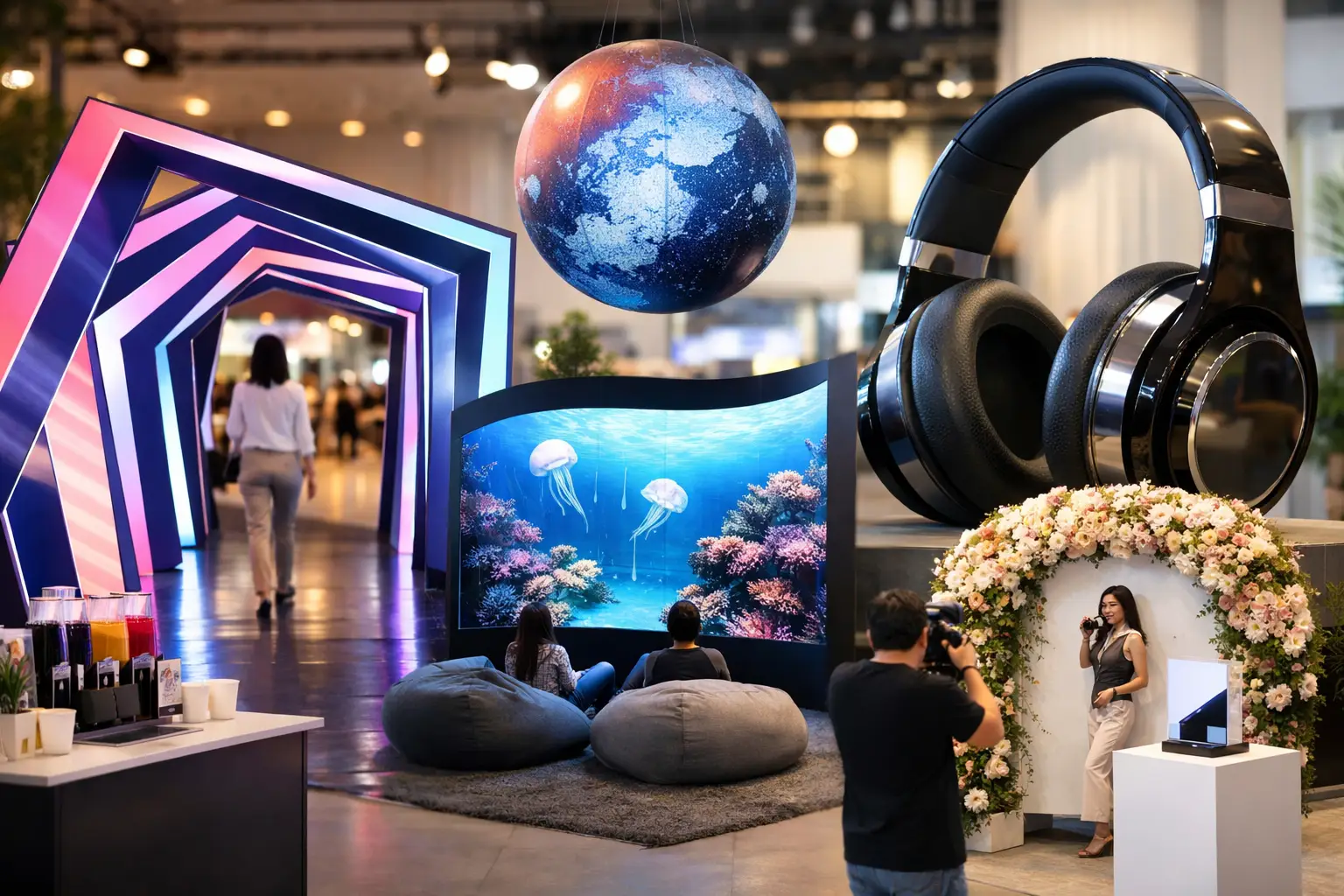
A branded installation has a short window to earn attention. On a busy trade-show floor, guests decide in seconds whether to walk past, take a photo, start a conversation, or remember your name later. The best ideas for branded event installations do more than fill space with logos. They give people a reason to stop, participate, and carry your brand beyond the venue.
For Canadian businesses, that means building around a clear commercial goal. Are you launching a product, collecting qualified leads, creating content, welcoming VIP clients, or making a large event feel more like your company? The answer should shape every material, screen, scent, light, and interaction.
Start With the Moment You Want to Create
A strong installation is not necessarily the biggest one. It is the one that makes sense for the audience, venue, and campaign. A tech company may need an interactive demo that makes a complicated product feel simple. A real estate team may need an immersive walkthrough that brings an unbuilt property to life. A premium consumer brand may benefit more from a polished photo moment than a dozen touchscreens.
Set one primary action before design begins. It could be booking a meeting, scanning a QR code, testing a product, posting a photo, or speaking with a representative. When every feature supports that action, the installation feels intentional rather than overloaded.
12 Ideas for Branded Event Installations That Get Attention
1. Build a larger-than-life product display
Make the product impossible to ignore. An oversized bottle, package, tool, vehicle component, or app interface can turn a familiar item into a visual landmark. This works especially well when the product has a simple, recognizable shape.
Scale alone is not enough. Add a practical reason to enter, touch, or photograph it. A giant product can house a sampling station, a video wall, or a guided product story. The result is a centrepiece that communicates the brand before a staff member says a word.
2. Create a photo set with a point of view
A logo wall is useful, but it rarely earns organic sharing on its own. Build a scene instead: a dramatic colour-blocked room, a branded motel check-in, a winter cabin, a mock newsroom, or an elevated version of the setting your customers aspire to enter.
The best photo installations make guests look good while making the brand unmistakable in the frame. Keep the mark present but integrated into the environment. If it feels like an ad people are standing in front of, participation drops. If it feels like a place they want to be seen, the camera comes out naturally.
3. Turn your brand story into a walk-through experience
For a milestone event, a product launch, or a company celebration, use a sequence of spaces to create movement and momentum. Guests might begin with the problem your business solves, move through key innovations, then arrive at a future-focused finale.
This approach is particularly effective for enterprise teams with a substantial history or a complex offer. Instead of handing visitors a brochure full of claims, let them physically move through the proof. Projection, sound, printed graphics, artefacts, and product displays can all play a role.
4. Use an interactive data wall
Data can be dry on a slide and compelling at human scale. A touch-enabled display or responsive projection can show local impact, customer choices, industry insights, campaign results, or a live event feed.
Keep the interaction simple. Ask one useful question, invite one selection, then deliver a visual payoff. A wall that requires a tutorial will create a queue of confused guests. A wall that reveals something personal or surprising can create a queue for the right reason.
5. Make the event entrance part of the campaign
The first ten metres of an event are often wasted on generic signage. A branded portal, illuminated tunnel, projected pathway, or sculptural entry can establish the atmosphere before guests reach registration.
This is a smart investment when the event itself is your brand platform, such as a conference, gala, client summit, or sales kickoff. It also gives photographers a repeatable visual asset, which matters when post-event coverage needs to look as polished as the room felt.
6. Design a live customization station
People value an item more when they help create it. Offer live personalization on hats, tote bags, product labels, notebooks, prints, or digital portraits. The giveaway becomes an experience, not another item destined for a storage drawer.
The trade-off is speed. Choose a customization method that can keep pace with attendance, and be honest about capacity. For a high-volume public event, fast options such as pre-designed patches or on-screen selections are often more effective than detailed, hand-finished work.
7. Bring an unbuilt space to life in 3D
For developers, real estate professionals, architects, and hospitality brands, an immersive 3D installation can close the gap between plans and emotion. Let visitors explore a future condo lobby, community, showroom, resort, or commercial property through a large-format screen, virtual walkthrough, or physical scale model supported by digital content.
The goal is not technology for its own sake. It is confidence. Buyers, investors, and partners make faster decisions when they can see proportion, finishes, amenities, and the broader vision in a way that feels real.
8. Create a quiet premium lounge
Not every installation needs to compete for attention with bright lights and loud audio. At a crowded conference, a well-designed hospitality lounge can be the most strategic branded environment in the building.
Use comfortable seating, considered lighting, charging access, refreshments, and discreet brand details to create a setting for better conversations. This is ideal for B2B companies where a meaningful ten-minute meeting is worth more than hundreds of casual scans.
9. Put guests inside a live content studio
A branded content studio gives your event a longer life. Set up a clean interview corner, product demonstration set, portrait station, or short-form video booth where speakers, customers, and team members can create material throughout the day.
Plan the questions and visual system in advance so each clip feels connected. A few well-produced customer reactions, founder interviews, or behind-the-scenes moments can provide months of social content after the event has wrapped.
10. Build a participatory art piece
Invite every guest to add something to a collective mural, light installation, tile wall, or digital canvas. Their contribution can represent a pledge, an idea, a vote, a city, or a goal for the year ahead.
This format works when community matters to the message. It creates visible proof of participation and gives organizers a strong final reveal. Just make sure the finished piece remains attractive even if attendance is lower than expected.
11. Use light, texture, and sound to change a simple footprint
You do not always need a custom build with a massive footprint. Strategic lighting, layered fabric, projection, textured surfaces, and directional sound can turn a standard booth or ballroom corner into a distinct brand environment.
This is often the right call when budget, load-in time, or venue rules are tight. Spend on the element guests will feel most clearly. For some brands, that is a dramatic lighting treatment. For others, it is premium materials and restrained graphics that signal quality without shouting.
12. Create a useful digital-to-physical experience
QR codes are not an experience by themselves. They work when they open the door to something worth accessing: a personalized recommendation, an event-only offer, a custom 3D view, a prize reveal, or a follow-up resource tailored to what the guest explored.
Connect the digital action to the physical installation. For example, a visitor can configure a product on a tablet, see their result projected on a wall, then receive it by email. That connection makes lead capture feel like part of the experience rather than an interruption.
Design for Operations, Not Just the Reveal
A concept can look exceptional in a rendering and still fail on event day if it ignores real conditions. Consider sightlines, power, Wi-Fi reliability, accessibility, crowd flow, cleaning, staffing, installation time, and what happens when a screen or interactive element needs attention.
Modular components are often worth considering for brands that exhibit more than once. A flexible system can be refreshed with new graphics, content, and lighting rather than rebuilt from scratch for every city. On the other hand, a one-night launch may justify a more theatrical, purpose-built statement because the earned media and guest experience are the main return.
The most effective installations also give staff a role. Equip the team with a simple conversation opener and a clear next step for each type of visitor. A beautiful environment attracts people; a prepared team turns that attention into business.
Make the Installation Feel Like Your Brand
The temptation is to borrow whatever is trending: neon signs, AI photo effects, projection tunnels, or oversized florals. Those tools can be effective, but only when they express something true about the business. A financial firm may need confidence and clarity. A youth-focused consumer brand may need playfulness and speed. A Calgary builder may need craft, scale, and a tangible sense of place.
One coordinated creative partner can make the difference between a booth with separate parts and an experience with one clear idea. Amydia brings event design, 3D visuals, brand systems, video, photography, and bespoke digital builds together, so the physical space and every screen within it speak the same language.
Before approving a concept, ask one direct question: would someone who never attended understand what this experience says about our business from one photo or thirty seconds of video? If the answer is yes, you have more than an installation. You have a brand moment worth building.

